

Discovering Immersive Scholarship: What is it and how can we use it?
As a student of Art History, I rely heavily on resources that I can find online, especially considering my interest in the visual culture of the South American Andes. I have been able to use 3D models and images to make up for the fact that I may never see many of these objects in person. Considering how much I rely on this software, I was inclined to apply to the Immersive Scholarship graduate assistantship that was being offered by the Digital Research and Scholarship offices.
Prior to taking this position, I did not really know what Immersive Scholarship was. What had prompted me to apply for the position was the fact that a lot of the GA’s responsibilities seemed to assist with creating more interactive and engaging educational models. I already had some experience working with photogrammetry and 3D modeling, I had completed an archaeological field school in undergrad, and I had experience in theatrical lighting that involved a lot of 3D modeling of light plots. Otherwise, I did not really have any context for what Immersive Scholarship was and what my responsibilities as the graduate assistant would be.
Since starting in the position at the end of August, I have learned an incredible amount about Immersive Scholarship and its prevalence across academic disciplines. It took a couple of weeks to put a solid definition on what Immersive Scholarship was. After familiarizing myself with the work of my predecessors (which you can read about in the Immersive Scholarship Blog), I had come to realize that Immersive Scholarship encapsulates a wide range of concepts, all of which come back to the use of virtual reality (VR) and 3D technology. Matt Hunter, FSU’s Digital Scholarship Librarian, and my supervisor, defines Immersive Scholarship as including “…research and teachings that utilize 3D data through the forms of 3D printing, virtual reality, augmented reality, and interactive 3D publications.” Various university departments across the country have some kind of initiative that is much like ours, but I have found that very few of them definitively define what exactly IS is. I am personally inspired by the Immersive Scholar project on the Open Science Forum, who claim to “address the utilization, scale, and impact of visualization environments and scholarship created within them.” [1] I also appreciated a past GA’s take on Immersive Scholarship, which has been used to create “edutainment” experiences in museums and libraries. [2]
I am still trying to come up with my own definition. Of course, I have only been in the position for two months, and I am still a student myself, but I hope by the end of my appointment here I will be able to define the field more accurately. But what I find most exciting about Immersive Scholarship is how it makes education interactive. It creates greater active engagement between students and subjects.
There is a plethora of projects that are utilizing this technology to increase participation and interest among their students. Archaeogaming is one of my favorite projects thus far. A blog dedicated to the discussion of using archaeology for video game design and development, there are several posts that discuss the use of video games in archaeology classrooms. The most recent post came from a professor who had her students play several archaeology-related video games in class to see what would happen. She reported that it increased her student’s interest in the material and overall engagement with her as a professor. They were asking more questions about the material after their interaction with virtual models of Roman artifacts rather than during a traditional lecture. Another project entitled Tactile Universe utilizes Immersive Scholarship to create accessible astronomical models for the visually impaired. They create 3D printed tactile images of galaxies that can be used in schools and at public events. By printing textured models, visually impaired students can recognize the raised texture of the models as the stars, and thus have a better understanding of the formation of galaxies and their general shape. You can read more about these projects at their websites or check out or annotated bibliographies to explore a variety of other initiatives that we have found interesting.
This idea of creating tactile models has been implemented across museums and libraries as well. I have seen such displays in art museums, which create tactile models of artworks so observers can interact with these pieces. FSU’s Museum of Fine Arts did this recently with their weaving exhibition, where visitors could feel various types of woven textile, and even weave themselves with the help of a museum intern at a loom. Here in the library, we are working with Special Collections to find way to make more accurate 3D models of their cuneiform tablets, implementing everything from paint for surface texture to weighing the tablets themselves so we can make models has heavy as the real thing. Furthermore, holding these models helps us better understand just how exactly they were meant to be used. This creates education much more of an active venture, which ultimately allows for greater understanding and retaining of knowledge being communicated.
What are we working on now?
If you have walked through the first floor of the Earth, Ocean, and Atmospheric Sciences (EOAS) building sometime within the past three months, you may have noticed a team of people taking specimens out of the shell display case. Immersive Scholarship at FSU has taken on assisting the Geology department in digitizing their collection of specimens. Two different cases exist on the first floor of the building, one containing mineral and the other containing a series of marine shells and fossils. Through the collaboration between Immersive Scholarship and the Geology department, we are looking to make this collection more accessible and interactive.
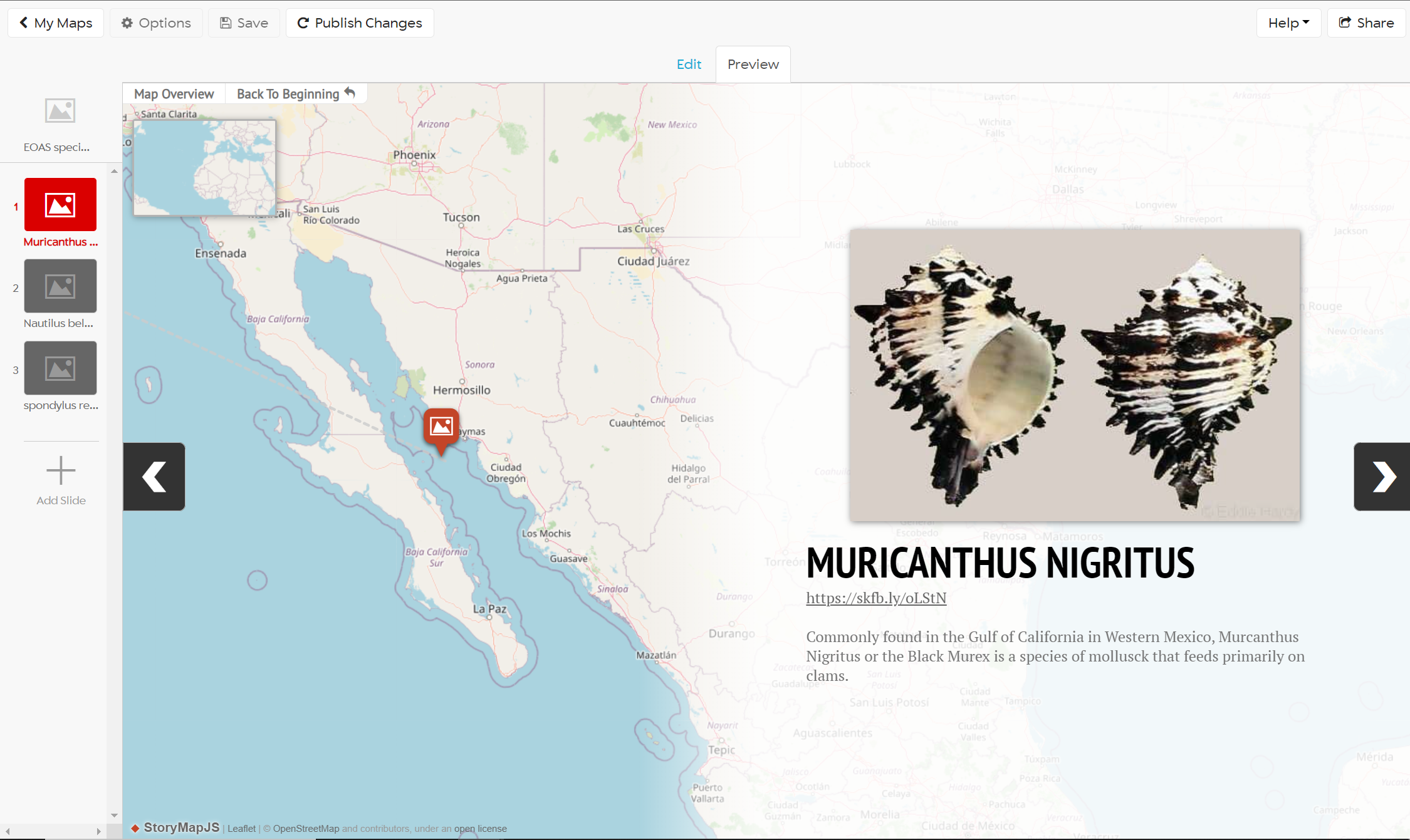
As the Immersive Scholarship graduate assistant, it is my responsibility to scan, process, and export the models. The final product of this process will be an interactive geo-spatial timeline, where students will be able to interact with these 3D models and see from where in the world they originated from. This will be available just by scanning a QR code with a smartphone, which will lead to the timeline we are working on. From here, observers can find links to each of these models that will be uploaded to Diginole, FSU’s digital repository. If you are familiar with our blog, you have likely already seen the Artec Spider Space Scanner in action. Through a combination of structured light and photogrammetry, the 3D scanner makes creating models much faster than traditional photogrammetry methods.
The first step of this process is taking several scans of the object. We do this by placing the object on a turn table and slowly turning it while holding the scanner at a specific angle. Each time we start a new scan, we either change the angle from which we take the images, or we change the orientation of the object, such as placing it on its side or turning it upside down, to make sure we get every detail. One model can have anything from three scans to over twenty, it generally depends on the size, shape, and color of the object. After a couple of rounds of this, I edit out any of the unwanted pieces of the scan, ie. parts of the turn table that we do not want to include in the scan. Once every scan has been edited, I align all the different scans. As you can see in the comparison below, just because we had scanned the object multiple times does not mean that each scan had the exact same orientation. Artec 15 has a pretty nifty feature that will auto-align the scans, but sometimes a manual alignment is necessary. To do this, I would just find specific points on each scan and one by one converge them until the entire model has been consolidated.
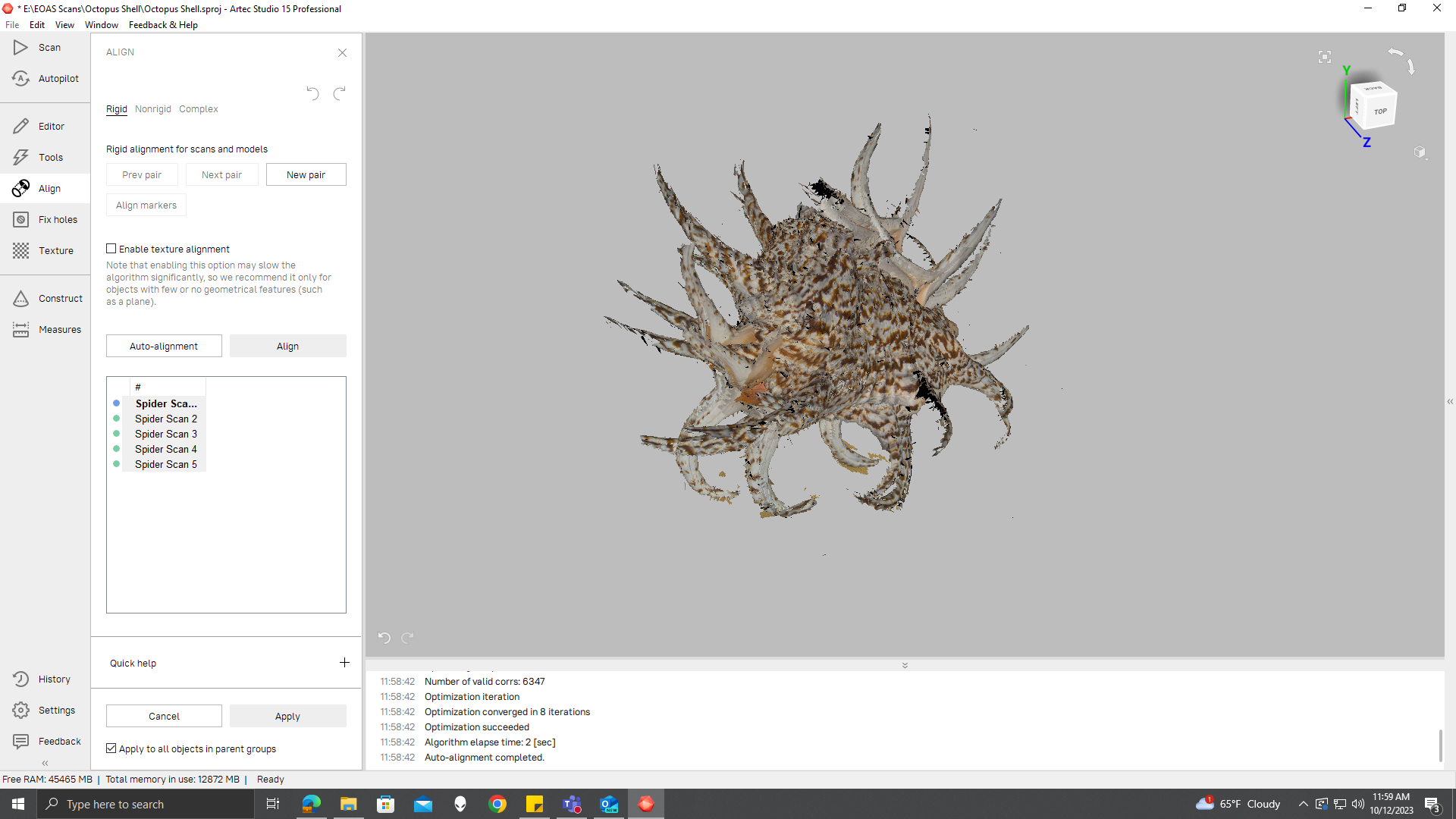
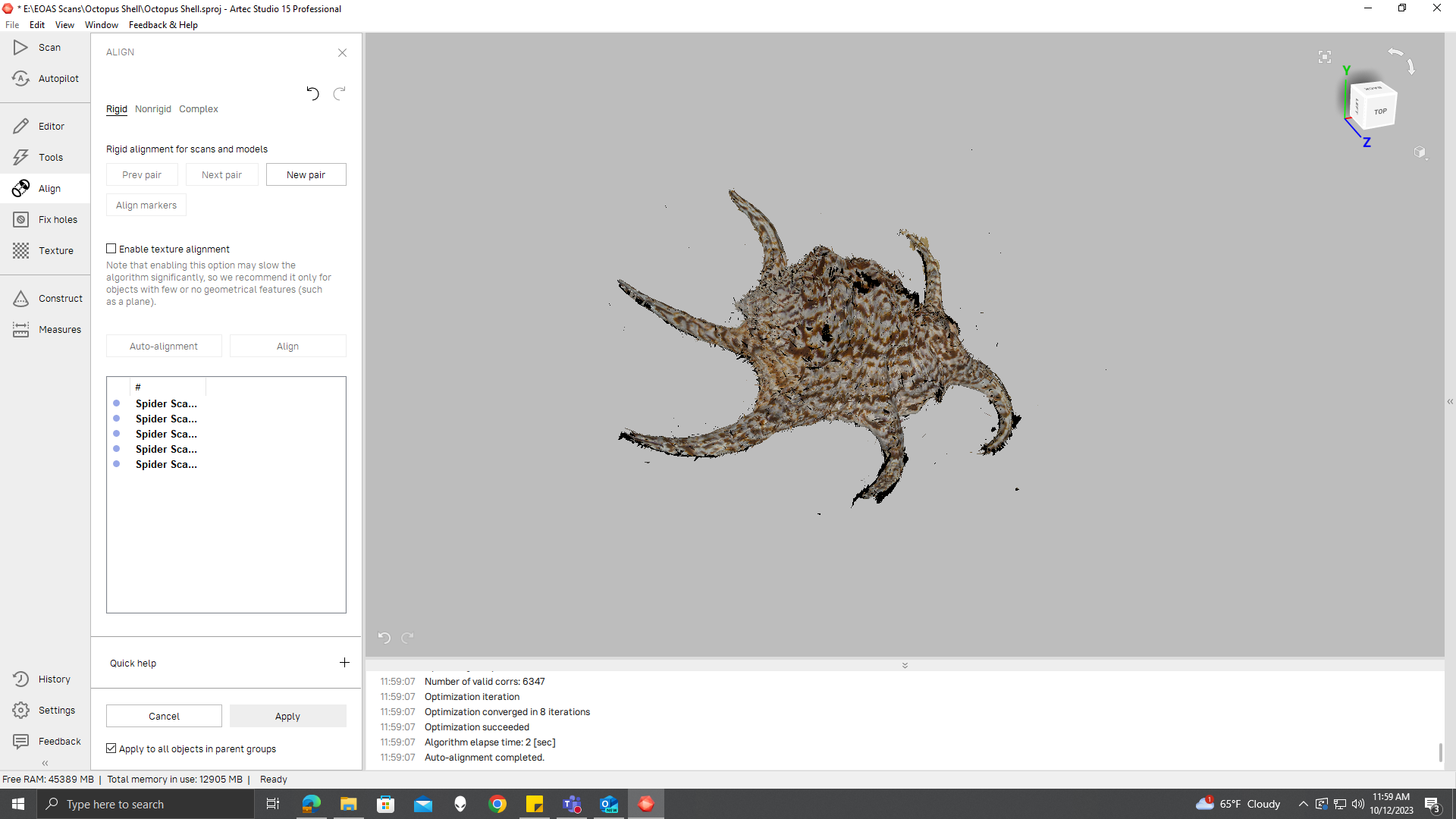
After aligning, I ran it through several programs including rough serial registration, fine registration, global registration, and an outlier removal to make sure it is properly cleaned and ready for fusion. There are three different types of fusion including smooth, fast, and sharp. We generally use sharp fusion because for these models, we want them to have as much detail as possible. Although, fast fusion is very useful if I am ever in a pinch, and if we are modelling an object that does not necessarily need to be perfectly detailed. After this has completed, we can go and apply the texture, and from here export the mesh to upload to repositories such as Diginole or Sketchfab.
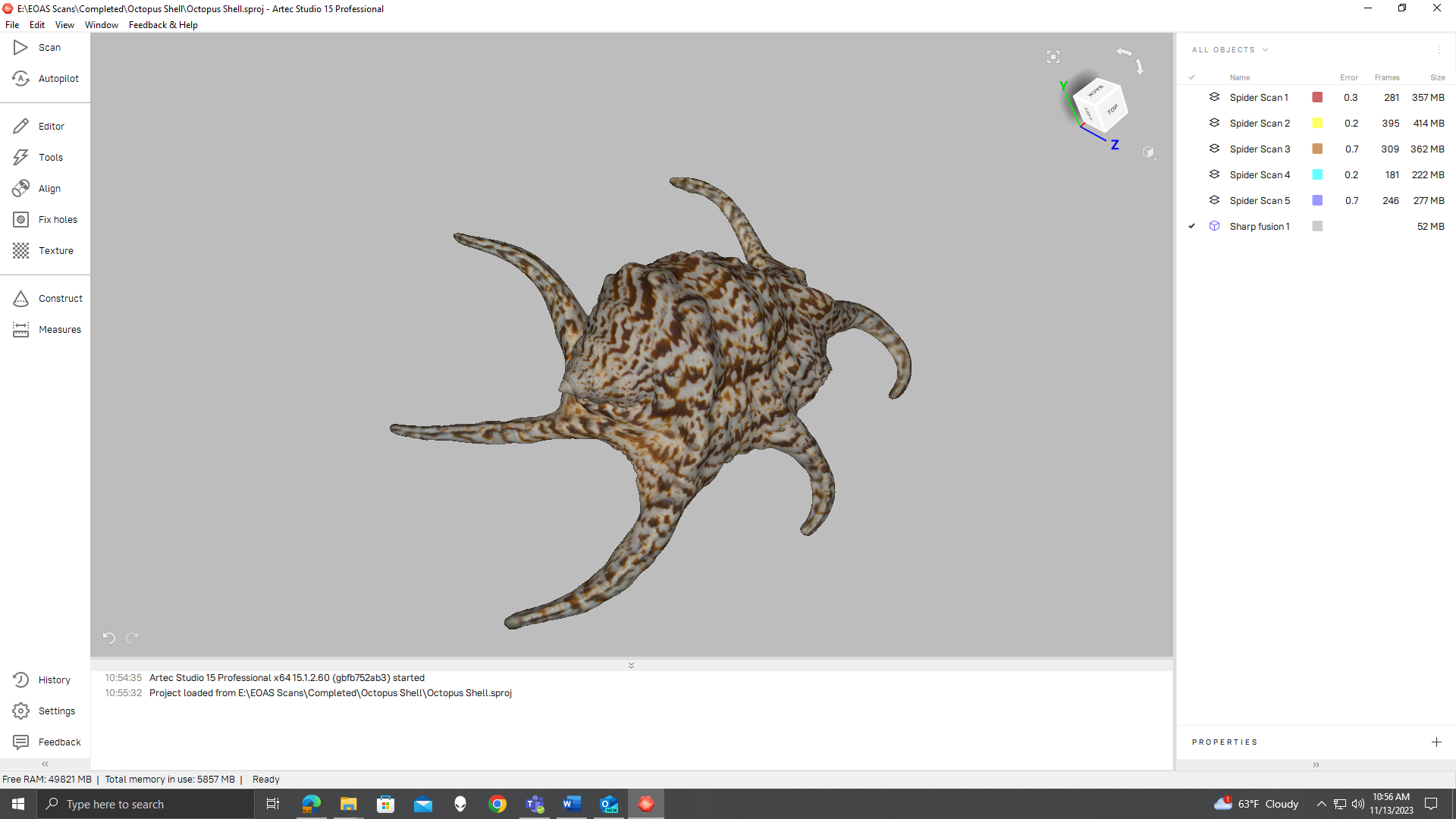
Eventually, anyone walking through the EOAS building will be able to interact with these specimens via their phones. We are also hoping to implement a geospatial timeline, so we can orient where these objects are coming from. As observers, it is easy to forget that these items have not always been behind glass. To see where these objects are coming from and to place them in a global context, we open doors to better understanding the world around us. Not to mention, it is always fun looking for smaller details you might have missed with a glass barrier between you and the object.
So, what is Immersive Scholarship? Right now, I would say it is a discipline that implements the use of 3D technology and virtual reality to create a more engaging educational experience. But even this definition seems too vague. I hope that through my experience as the Immersive Scholarship Graduate Assistant will help me develop this definition and bring more attention to a field that many people do not know too much about.
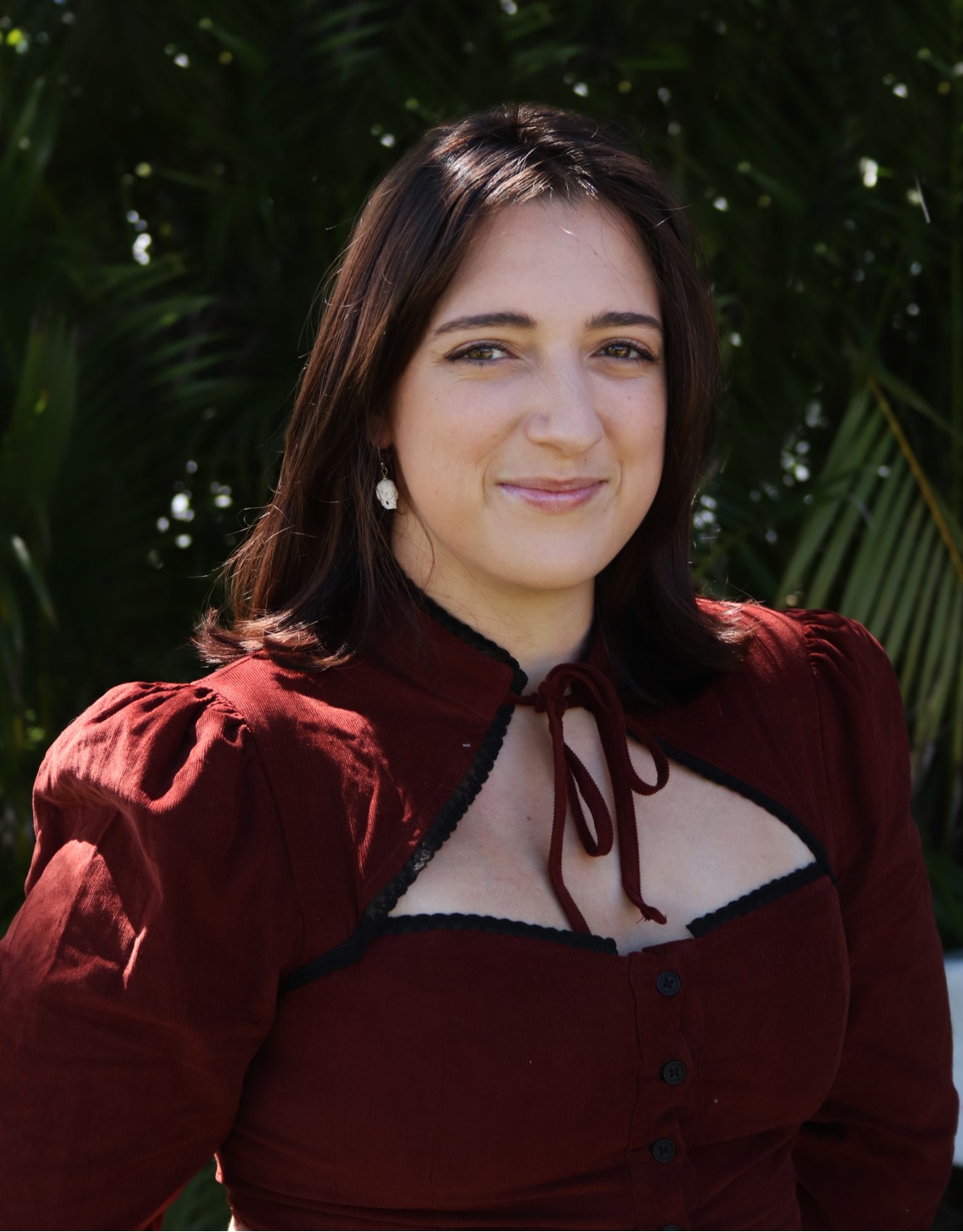
Tanya Pattison
Immersive Scholarship Graduate Assistant
Archaeogaming: I had my students play games for my class to interesting results – Archaeogaming
Tactile Universe: Tactile Universe – Making current astronomy research accessible to the blind and vision impaired community
[1] OSF, Immersive Scholar Visualizing Digital Scholarship in Libraries and Learning Spaces” 2021.
[2] Yatil Etherly, “Exploring the Capabilities of 3D Digital Technologies for Research and Education at Florida State University Libraries: Part One,” 2022.


